Studies & Evaluations

Evaluation of the Open Parachute Program
An Evaluation Study revealed that educators who implemented Open Parachute reported increased confidence in managing classroom mental health concerns, greater comfort discussing their own mental health, and enhanced ability to guide students through emotional challenges.
- Increased student abilities to manage stress, build self-esteem, and seek support, with measurable improvements in handling well-being challenges post-program participation.

- Enhanced student capacity to articulate personal challenges and apply coping strategies independently, reflecting growth in self-awareness and problem-solving.


Feasibility and Acceptability Studies
The Feasibility and Acceptability Studies confirmed the program's relevance, user-friendliness, and adaptability within diverse educational settings. Educators reported high levels of satisfaction with the program content, delivery format, and its impact on student well-being.
Positive perceptions of student engagement and responsiveness, with educators noting high levels of attention and participation.
Increased teacher confidence in addressing mental health topics within classroom discussions.
Greater teacher confidence in guiding students to resolve challenges, including peer conflicts and academic pressures.
Strengthened educator skills in providing emotional support to struggling students.
Student Insights from the Open Parachute Program in Canada
A qualitative study involving 761 Grade 5 and 6 students across nine Canadian schools explored how students understood and applied Open Parachute learning in everyday life. Students described emotional awareness, practical coping strategies, and confidence in seeking and offering support.
- Students applied practical coping strategies, including managing anxiety and anger, using breathing techniques, asking for help, and resolving conflict.
- Peer lived experiences helped normalize difficult emotions, reinforcing that students were not alone while building understanding and empathy for others.
- Students described confidence in seeking support from trusted adults, teachers, friends, and family members.
- Students demonstrated empathy and prosocial behaviors, including supporting peers, standing up to bullying, and repairing relationships.
Small Shifts, Big Differences: Grade-Level Patterns in Mental Health Stigma
A quasi-experimental study of 1,778 Grade 6–8 students across five Greater Boston middle schools evaluated a four-week Open Parachute program. Grade 8 students showed a significant reduction in self-stigma relative to controls.
Grade 8 students showed a significant intervention effect for self-stigma (p = .005), while self-stigma increased among control students.
The findings suggest stigma-focused content may be most effective when aligned with students’ developmental stage.
Grade 6 students improved across both groups, while Grade 7 students showed little change.
Australian Friendship Skill-Building Study
A quasi-experimental Australian study involving 193 Year 5 and 6 students found that students completing a 12-week Open Parachute intervention demonstrated significantly greater friendship knowledge acquisition than control students.
- Students showed significantly greater growth in their understanding of friendship skills compared with controls.
- The program strengthened foundational knowledge for navigating friendships, communication and peer challenges.
Open Parachute @ Home
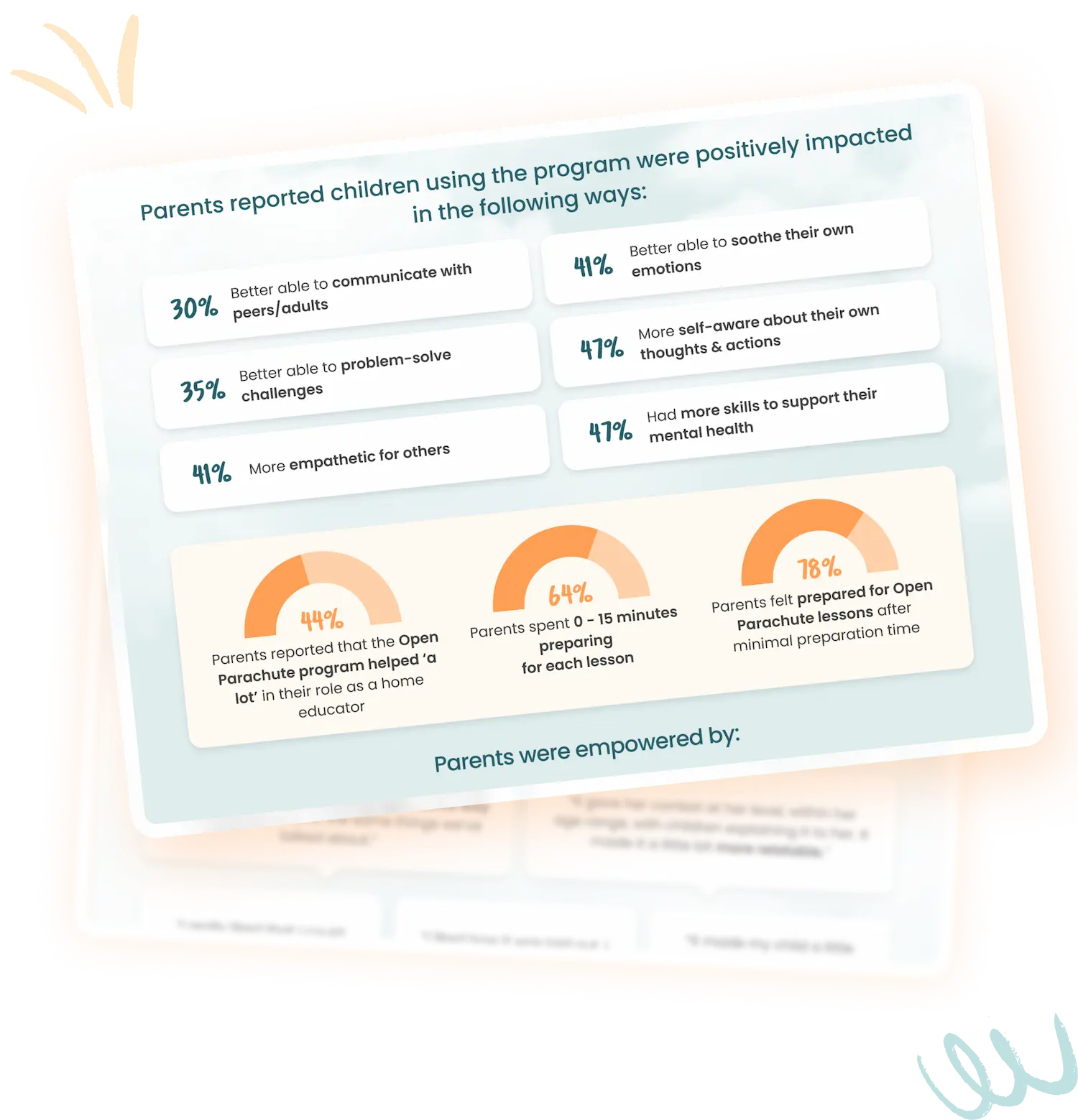
A University of Calgary evaluation explored Open Parachute with home-educating families of children aged 5–18. Parents reported the program was easy to deliver and supported stronger mental health conversations and practical well-being skills.
78% of parents felt well prepared to deliver the program, with most spending five minutes or less preparing each lesson.
Parents rated the program 8.5/10, highlighting its accessibility, relatable peer stories, and flexibility.
56% felt more comfortable discussing mental health with their children, while parents also observed growth in emotional awareness, coping, empathy, and communication.
Parents observed improvements in their children’s emotional awareness, coping skills, empathy, communication, and problem-solving.
The Ripple Effect on Educators
This research investigates what happens for teachers themselves when they deliver Open Parachute mental health and well-being lessons.
- Explores potential impacts on teacher well-being, confidence and self-efficacy, psychosocial safety, and relationships with students.
- Combines pre- and post-program measures with interviews to understand both the professional and personal experience of teachers delivering the program.
Student Voices and Peer Lived Experience
This doctoral research explores how Open Parachute’s peer lived-experience approach may influence the mental health and well-being of Year 5 and 6 students in South Australia.
Examines students’ wellbeing, social awareness/identity, and responsible decision-making over time.
Uses surveys, focus groups and classroom observations to understand how students experience and apply learning from same-age peer stories.
School Leadership and Well-being
This doctoral project explores how school leaders view the role of mental health and well-being programs in achieving broader educational goals.
- Investigates how leaders prioritize, integrate and evaluate well-being programs within their school strategy and local context.
- Examines how programs such as Open Parachute may contribute to student outcomes, school improvement and the long-term sustainability of well-being initiatives.
Connecting Home, Well-being and School Engagement
This research explores the relationship between the home environment, student mental health and well-being, and engagement with school from the perspectives of young people and their families.
Prioritizes student and parent/caregiver voices to understand the factors at home that may support or challenge wellbeing and school engagement.
Aims to identify opportunities to strengthen home–school partnerships and connect family, wellbeing and school-engagement initiatives.
Ongoing Research
Ongoing evaluations are helping us strengthen the evidence base and better understand implementation, student outcomes, and long-term impact.